

It started with what felt like trapped gas.
A young mother, just under 30 days postpartum after a traumatic 27-week emergency cesarean, began experiencing right-sided chest and abdominal pain. She tried home remedies. She tried to rest. But when the pain became unbearable in the early hours of the morning, she did what any worried mom would do — she drove to the nearest hospital.
That decision, and the doctor waiting for her there, saved her life.
A story that almost had a very different ending
Dr. Jaleen Sims, an OB/GYN hospitalist in Mississippi, was on duty when the patient arrived at the OB emergency department. On the surface, nothing screamed emergency. Vital signs were largely unremarkable. Oxygen levels were mostly in the normal range. Lab work came back clean. Her lungs sounded clear.
The most likely explanation? A muscle spasm.
But Dr. Sims did not stop there.
“There was just something about her story and her exam that raised an eyebrow for me,” Dr. Sims recalled.
The patient’s history was significant. She had delivered at just 27 weeks due to preeclampsia — a dangerous blood pressure condition caused by pregnancy — and a placental abruption, where the placenta separates from the uterine wall. Both conditions are serious obstetric emergencies. And postpartum patients who have had cesarean sections carry a heightened risk for blood clots.
With that context in mind, Dr. Sims ordered a CT scan of the chest and abdomen.
The results were alarming. Blood clots in both lungs. And in the right lung, an area of tissue that had lost its blood supply entirely.
The patient was admitted immediately, started on blood thinners, and a hematology consult was arranged for that same morning.
Why 1 AM made all the difference
It was between 1 and 3 o’clock in the morning when all this unfolded. The patient’s private physician was not at the hospital. The on-call doctor was potentially 30 minutes away. Without a hospitalist physically present and ready to evaluate her, this patient could easily have been sent home with a diagnosis of a muscle spasm, and never made it back.
“This emphasizes the value of having an obstetrician in the hospital 24 hours a day to evaluate and manage emergency cases like these,” Dr. Sims said.
This is the promise at the heart of the Ob Hospitalist Group model. Rather than relying on physicians who split their time between clinic appointments, office patients, and on-call emergencies, OB hospitalists are dedicated to the hospital — present, focused, and ready — around the clock.
The words that said it all
When the patient recovered, she did not offer a formal statement or a lengthy review. She said six words.
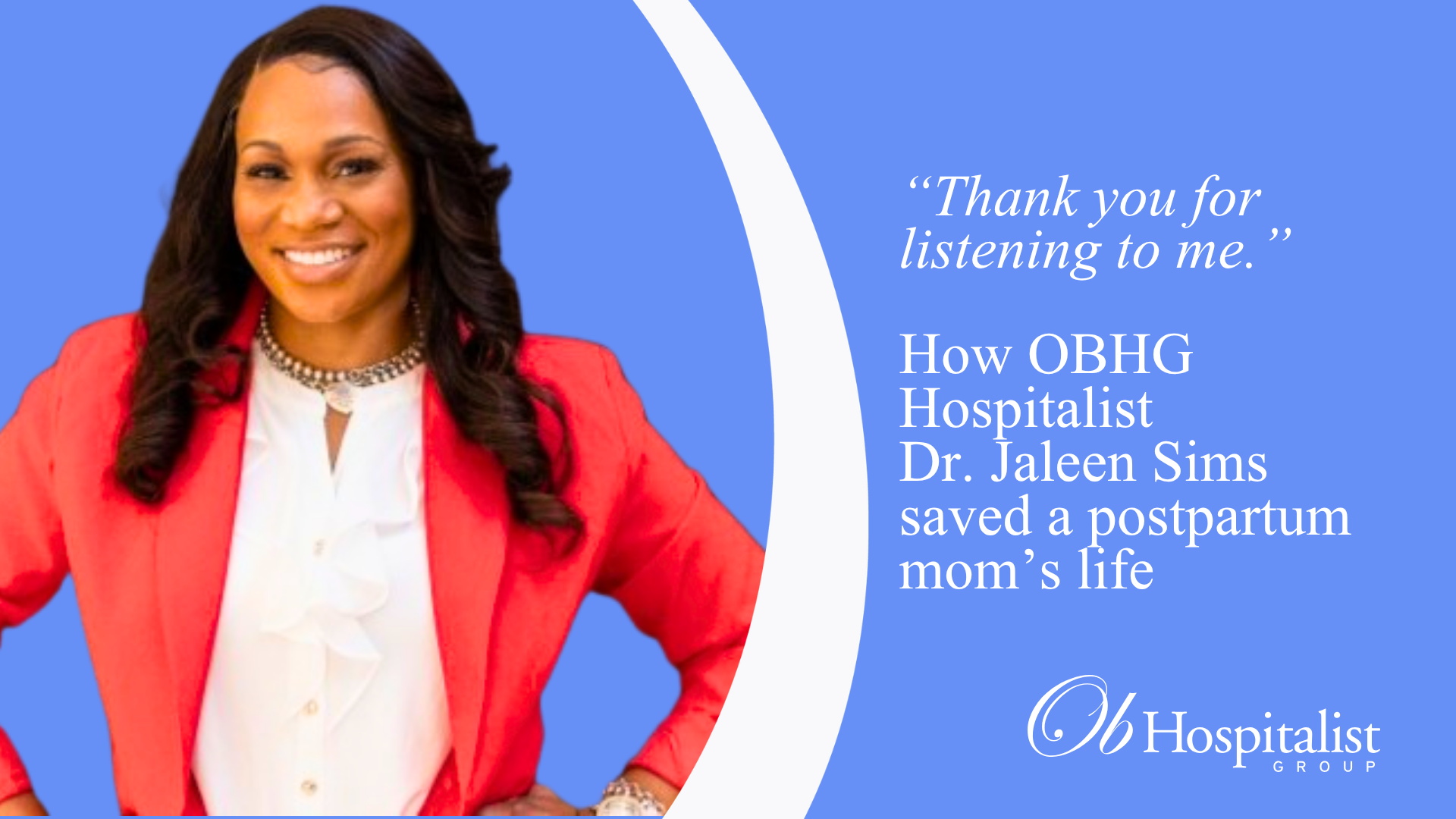
“Thank you for listening to me.”
For Dr. Sims and her team, those words carried the full weight of what their work means. Too often, patients recount stories of being dismissed, rushed through evaluations, or sent home without answers. Too often, the outcome is far worse.
“There are so many cases that you hear about with suboptimal outcomes, and the patients will come back and say, ‘They didn’t listen to me, they didn’t take the time,'” Dr. Sims reflected. “Being a hospitalist in this case was truly a blessing to the hospital and the patients, because we’re not having to rush between clinic and hospital patients. We actually have the opportunity to focus in and really take the time to listen to patients, evaluate them, and manage them in a very timely fashion.”
The bigger picture
Maternal health outcomes in the United States — and particularly in the South — remain a serious concern. Postpartum complications are among the leading causes of preventable maternal deaths, and many of those deaths happen in the days and weeks after a patient leaves the hospital, when warning signs go unrecognized or are not taken seriously.
Stories like this one are a reminder of what is possible when the right clinician is in the right place at the right time.
Dr. Sims did not save this patient’s life with a complicated procedure or a rare intervention. She saved her life by listening, by digging deeper when the easy answer would have been to send her home, and by being present — physically, in the hospital — when it mattered most.
That is what Ob Hospitalist Group is built to do.