

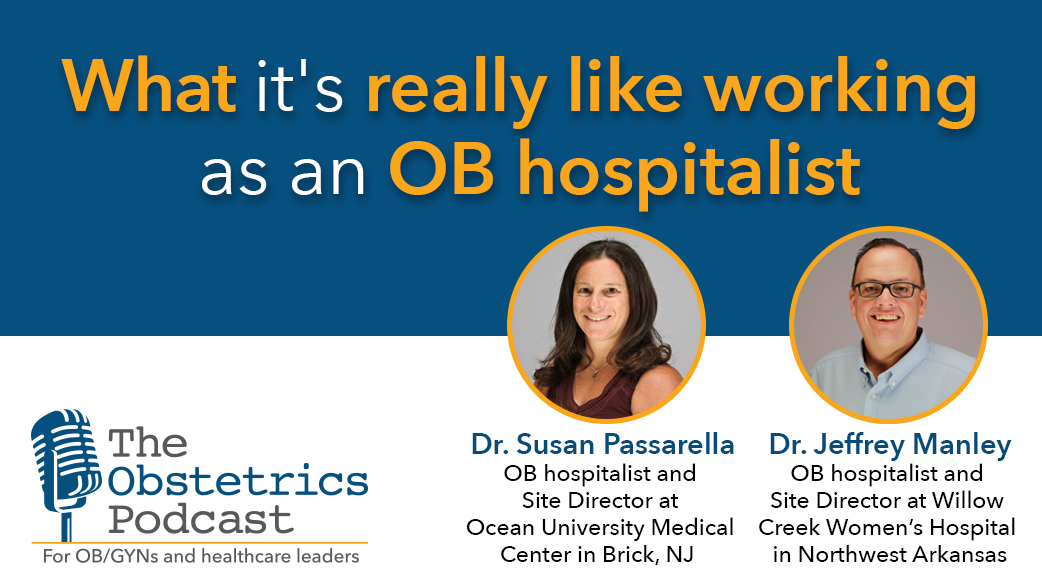
The field of obstetrics plays a crucial role in healthcare, addressing the unique needs of expectant mothers. To keep pace with growing demands, the significance of OB hospitalists is on the rise, making them increasingly indispensable in the medical landscape.
Dr. Susan Passarella, Ob Hospitalist Group Site Director at Ocean University Medical Center in Brick, New Jersey, and Dr. Jeffrey Manley, Site Director at Willow Creek Women’s Hospital in Northwest Arkansas, share insights into what is involved in being an OB hospitalist.
The many sides of being an OB hospitalist
Transitioning to an OB hospitalist isn’t without challenges. For Dr. Passarella, there were two factors she faced when making the jump from private practice to her OB hospitalist career: narrowing her scope of practice from obstetrics and gynecology to just obstetrics and the potential of losing her gynecological skills.
“You go through your training to really encompass that full course of the whole patient’s life and that continuity of care, and then you give that up. I think that was one of the more challenging things to give up, that continuity of care. I thought I would be taking care of those patients for their entire lives,” she states.
She was also concerned that she would lose some of the gynecological skills OB/GYNs work so hard to excel at. There is some element of gynecological medicine as an OB hospitalist, but not guaranteed as often as being in private practice. However, most all the gynecological surgeries that happen as a hospitalist are unplanned and often an emergency situation, thus making sure her skills are practiced and always ready for the unexpected.
“I think the patients we deal with – whether they have a ruptured ovarian cyst, ectopic pregnancies, ovarian torsions, or are in the process of miscarrying – are very unstable. You must really act quickly to provide them the best and the safest care and get them to the operating room. I think it’s actually improved my skills because we have to be very quick and precise about how we treat those patients that can’t be put off. I always say I’m very grateful for the GYN training I had, because it really made me a great surgeon and I feel comfortable and confident in who I am. Again, you never really know what you’re going to see on a day-to-day basis. You must be prepared to handle any of that,” Dr. Pasarella says.
There are also plenty of wonderful aspects of being an OB hospitalist. Dr. Manley shares that he loves being in the hospital setting, and he loves delivering babies.
“I think I was a little worried about being a hospitalist full time, just because I didn’t know how much I would miss the other things in life. It’s extremely rewarding to be able to be at the bedside within a moment’s notice which really puts the patient at ease. The patient feels that comfort level of having a doctor right there with them the entire time or readily available—even though it may not be their own doctor. It certainly gives me comfort knowing I’m there,” he says. “We spend a lot of time at the hospital which I have always enjoyed. To be honest, clinic is just not my thing. I really love the hustle and bustle of the hospital setting. You also hone the ability to develop trust and establish a rapport with a patient in nine minutes instead of nine months,” he says.
The value of work-life balance
One significant perk of being an OB hospitalist is the reduced responsibility of “busy work,” like charting, scheduling, and billing. Dr. Manley recalls one vacation where he was doing charts every morning, as well as checking in with his nurses. Both he and Dr. Passarella don’t miss that aspect.
“Once I made the switch from private practice to being a hospitalist, I went out to one of the OB hospitalist society meetings and found I enjoyed improving patient safety, giving quality care to the patients, and really elevating that standard of care at the hospital. Once I got that insight and saw the difference that we make, I really started to enjoy it. I love my quality time with family and my friends, and I think work is really a balance. This to me was the perfect fit. It allowed me to spend quality time with my patients when I was in the hospital and give them 110% of my attention, and it also gave me the ability to give 110% of my attention to my family and friends at home. Most importantly—it gave me time for myself,” she says.
The work-life balance also makes it worth it for Dr. Manley. “Because we are working 24-hour shifts, you get home and sometimes you’re exhausted. So in that aspect it’s not for everybody. But it creates opportunities for us as physicians to have that balance in our personal lives. That’s really why I decided to do this. When you work 70-80 hours a week, it wears on you after time. Working five to seven shifts a month fit for me and I don’t ever see myself going back to private practice.”
Listen to the full podcast below.
Ready to expand your career with OBHG?
Our recruiters want to help you find the job location that’s the best fit for you and your family.
Browse our interactive careers map to investigate all clinical openings across the country. Or send us your CV today and we’ll be in touch!