

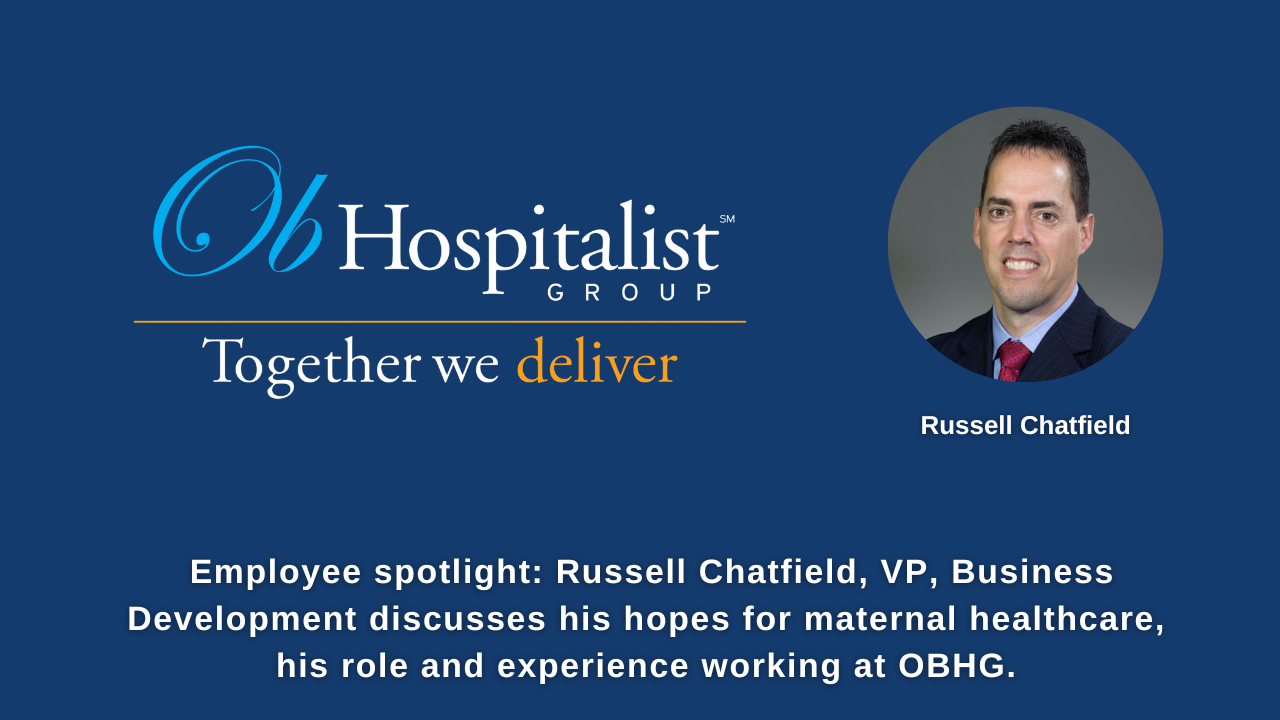
Today we’re highlighting just one of OBHG’s many employees who are making a difference every day at Ob Hospitalist Group. We sat down with Russ Chatfield from our Business Development team and asked him a few questions about his role, the company, and the industry.
Russ Chatfield is Vice President of Business Development for the East region. He has been with Ob Hospitalist Group for seven and a half years. His primary role is to seek new business partnerships with hospitals throughout the East – from Maine to South Carolina.
During a typical day, Russ has lots of conversations with hospital leaders and leads presentations. He also spends time making sure that customer implementation and onboarding for new OBHG hospital customers is going well. “One of the things that’s made me successful at OBHG is delivering on what I promised to my customers. I’m also here to support my team to make sure if they have hospitals they’re speaking with that I’m part of the process as well, to help make sure we can deliver on that promise.”
What is the question that hospital leaders ask the most?
“I would say one of the most common ones I get from a Chief Medical Officer or even a CEO is ‘How can Ob Hospitalist Group staff when we are unable to as a hospital?’ For instance, what attracts OBs to Ob Hospitalist Group and not their hospital or hospital system? That’s the most common question, and many of them even take it a step further and say, ‘We’ve been recruiting for two years. How will you say you can stand up a program in seven to eight months?’ So those are the most common I would say – it’s around human capital on how we’re able to do it when they can’t.
It’s a multifold answer. First and foremost, the first thing we explain is that our catchment area is much larger than the hospitals. For instance, a lot of hospitals want their physicians to live within 30 minutes, versus our OB hospitalists may live 90 to 120 minutes out, because they come in and they’re driving in for a 24-hour shift, and they’re not coming back for a few days. So, they don’t need to have a practice close by.
The second thing is, we often sell on the Ob Hospitalist Group name, we have over 1,500 OBs who work for OBHG, and some of them are looking for a very particular lifestyle and want flexibility. For example, let’s say that an OBHG physician wants to work in Massachusetts, and they work there for a couple of years, and then they say, ‘I’m going to go retire down in Florida.’ Well, guess what? OBHG has programs throughout the country, and that gives that physician the flexibility to do what their lifestyle is asking for.”
What makes us different than other OB hospitalist programs?
“I would say our deep singular focus on obstetrics, the only area of medicine that OBHG does makes us stand out from other OB hospitalist providers. When I get in front of a hospital, I talk about the quality. How we can move the needle on quality, we can move the needle on standardization of care, and we can reduce the Med Mal profile of hospitals we partner with.
We’ll sometimes take over a do-it-yourself program and the reason they’re even considering OBHG is because they don’t have the site director, they don’t have the management oversight, they don’t drive quality through ACOG or other standard guidelines. So really, they’re looking for someone that’s going to drive a quality program and take it off their plate. And that’s why they often turn to someone like OBHG.”
Are there any trends specific to your region?
“The only thing I would say about my region is a lot of the hospitals do in fact, have some form of residency component. In the past, where they may not have looked at OBHG, because they said, ‘Well, we have residents.’ Now they’re taking a different look at us because they want someone to work closely with their residents because their physicians are getting burned out doing everything. And the Northeast, specifically, New Jersey, New York and Pennsylvania do have a lot of homegrown do-it-yourself hospitalist programs. So I do see a trend, and more hospitals that want to talk to us than in the past.”
What is something you wish others knew about your job?
“I feel like it takes true passion and believability on our services which I bring to each one of our hospital conversations.”
What are your hopes for the industry?
“My hopes for the industry are specifically that more OBs come and work for Ob Hospitalist Group. And that it becomes a lot easier for us to recruit physicians into each one of our hospital partners. For hospitals, I think about it in two different buckets, we’re going to have OBs in the community that are really going to focus on patients and then we’re going to have OB hospitalists (it doesn’t even have to specifically be Ob Hospitalist Group physicians) running the labor and delivery floor. If we put it into those two different buckets, then I think the industry will start to shift.”
How does it feel to know that you have indirectly impacted the lives of thousands of women and families during your career? (Russ has brought on over 50 programs/hospitals, impacting the lives of approximately 85,000 women’s lives – and their families.)
“Honestly, I feel blessed, I absolutely love what OBHG stands for. And I also love what I do at Ob Hospitalist Group. I also realized, and I think you guys have heard this through my conversation, that it’s not just me, it’s me and a team of people. And we’ve been so successful in the east in regard to bringing on new partnerships and having a very low attrition rate with our hospital partners. I am very passionate about what I do. And I think that’s why I have been so successful because what’s not to love about making sure that every mom and baby is going to have the best possible outcome and the lifesaving care stories that we hear on a weekly basis from our physicians are amazing. So yeah, I’m very passionate about what I do. And I think that’s what’s made me successful, honestly.”
What are your hobbies?
“I spend time with family, friends and loved ones which is the most important passion of mine. I also love to boat, fish, golf, and cycle on the roads, as well as travel when time allows. So those are my passions. You know, anything outdoors related, I’m very outdoorsy, and then obviously, family time is most important.”
What is one piece of advice that’s impacted you most?
“I found a job that I’m truly passionate about. And if you love your job, then it’s not really a job. I’m not trying to tell you that I don’t have some lofty goals on my shoulders. But I absolutely love what I do. And that’s what my advice is – if you’re passionate about what you do, your job is not really a job. It’s a passion.”