

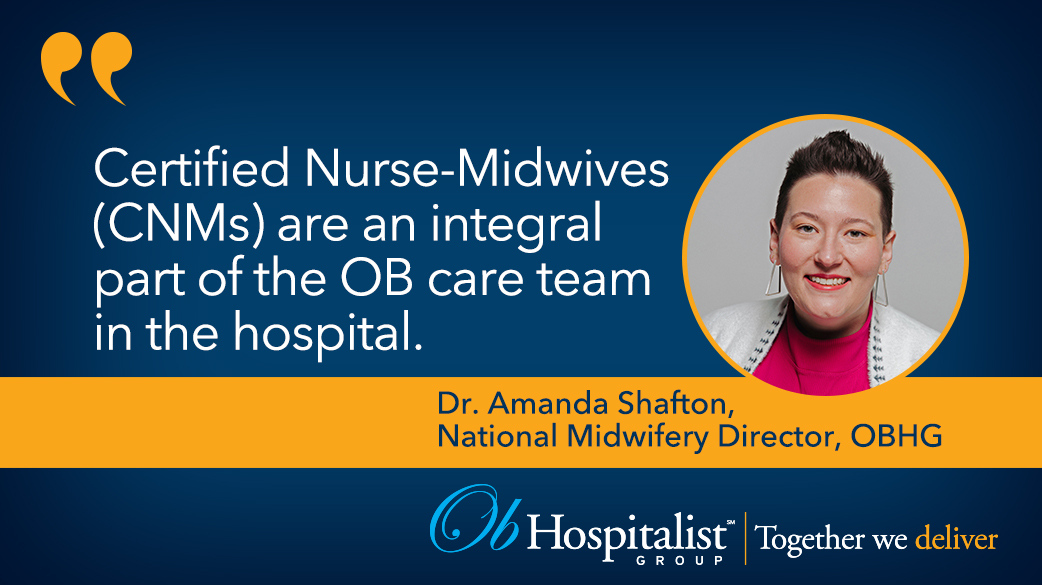
Earlier this year, Ob Hospitalist Group welcomed Dr. Amanda McPherson Shafton, DNP, CNM, FACNM as the first National Midwifery Director.
With midwifery care proven to reduce unnecessary interventions and improve care, OBHG is excited to expand our current bench of over 200 Certified Nurse-Midwives (CNMs). Dr. Shafton’s passion to advance midwifery care, especially for more vulnerable communities, will further our mission to improve outcomes for mothers and infants.
In a recent discussion, Amanda discussed the state of midwifery care in the United States, including challenges and next steps to encourage widespread adoption of the midwifery model.
What is a Certified Nurse-Midwife (CNM) and how do they differ from OB/GYNs?
A Certified Nurse-Midwife (CNM) is a highly trained healthcare professional with a particular focus on pregnancy, childbirth, postpartum care and reproductive health. The primary difference between CNMs and OB/GYNs lies in their training and scope of practice. While both CNMs and OB/GYNs can provide prenatal care, deliver babies and offer postpartum support, CNMs often take a more personalized and less interventionist approach for low-risk pregnancies, while OB/GYNs are trained to intervene in high-risk situations and perform surgical procedures such as cesarean sections.
Why is it important to have CNMs involved in OB care in the hospital?
CNMs are an integral part of the OB care team in the hospital. The midwifery model allows for more time with patients – CNMs are often able to spend more time listening and meeting patients where they are. When CNMs and physicians work in tandem, with CNMs handling low-risk cases and OBs managing surgical or high-risk patients, both clinicians are able to work at the full extent of their scope of practice, improving outcomes for moms and babies alike.
What is something physicians don’t understand about CNMs? How does OBHG work to bridge the gap so that CNMs and OBs work well in tandem together?
Because midwifery is not the de facto care option for expecting parents, many physicians and hospital systems don’t always recognize the value of CNMs and their full scope of practice. The depth of expertise and the essential role CNMs play as OB providers in a wide-variety of settings is not well understood, which is why OBHG works so diligently to identify the right people to engage in meaningful conversations and break down misconceptions.
OBHG is a strong advocate for integrating CNM care in hospital settings, and we recognize that different communities and programs have different needs. It starts with an honest conversation with hospital leadership and physicians to highlight the critical contributions of midwives, whether they are leading clinics, managing triage, or running labor and delivery units. Midwifery care can take on many forms in a hospital setting, whether that care is consultative or collaborative with OB/GYN physicians. In many cases, CNMs can serve as the primary provider on-call, with physicians stepping in as backup when needed, reducing costs and improving patient outcomes.
How do CNMs, as part of an OB hospitalist team, play a role in the U.S. maternal mortality crisis?
Personally, I believe midwifery care is the answer to almost every single problem we have in our country in terms of obstetrics.
While every other country is making improvements, we are the only developed country where maternal mortality rates have gone up. The countries with the lowest rates are those who prioritize midwifery-based care, with 80-90% of babies being delivered by midwives. This doesn’t mean we don’t need the obstetricians and maternal fetal medicine doctors, it just means these countries typically standardize a collaborative approach, delegating the majority of patient care to midwives, supplemented by physicians when necessary. When physicians and nurse-midwives collaborate, patients have better outcomes.
What are some of the challenges nurse-midwives face in practicing their full scope?
Aside from a general lack of knowledge or awareness of CNMs, there are several bureaucratic barriers that vary by state. While OB physicians can practice in essentially the same way across the country, not all CNMs are able to practice to the full extent of their scope, despite having the same educational requirements in every state. Currently, only 27 states and the District of Columbia allow CNMs to practice at the full extent of their scope. Three states require physician supervision, and 20 states require a signed collaborative practice agreement with a supervising physician.
In addition to state requirements, many individual hospitals don’t have bylaws that allow non-physicians to be on medical staff, preventing CNMs from working to the full extent of their knowledge and licensure. As patient outcomes are worse in states where nurse-midwives don’t practice at the full extent of their scope, there is an urgent need for policy reform in a state and to allow CNMs to increase their scope of practice in more states.
How do we increase the amount of CNM providers?
Ultimately, it comes down to increasing the visibility of midwives as essential parts of the OB care team. Whether this is direct outreach or securing better funding for scholarships and midwifery education, it’s crucial to make becoming a CNM more accessible, especially for future clinicians of color to ensure a diverse and inclusive group of midwifery providers that better represent the communities they serve.
OBHG is excited to partner with Frontier University, one of the largest educators of nurse-midwives in the country, to help midwifery students find clinical placements in OBHG hospital programs. By engaging students in clinical settings early on, OBHG provides hands-on experience and fosters a supportive learning environment, encouraging more students to pursue and complete their training as CNMs.