


OB/GYN clinicians may not routinely face many cases of maternal sepsis; for every 10,000 live births in the U.S., only about 10 are complicated by the condition. But when those few cases do occur, they’re taken very seriously by physicians like Dr. Eric Colton, senior market medical director and site director at OBHG partner Blessing Hospital in Quincy, Illinois.
That’s because maternal sepsis is a leading cause of maternal mortality, accounting for 23% of in-hospital maternal deaths in the U.S., studies show. Sixty-three percent of those deaths might have been prevented with early detection and intervention – statistics that have inspired Dr. Colton to champion improved protocols.
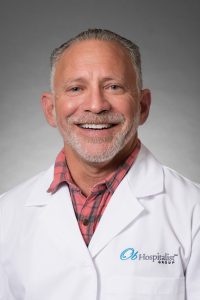
“Knowing this really pushed myself and my team to incorporate the best possible care when we encounter patients at risk for developing sepsis,” said Dr. Colton, whose ongoing advocacy and leadership – along with his team’s handling of a recent sepsis case – prompted Blessing Hospital to award him the golden Sepsis Hero pin he now wears on the lapel of his white coat.
To SIRS with (tough) love
The case hit close to home, involving a patient who rapidly became hypotensive shortly after delivering her first baby.
The cause would have been easy to miss. Diagnosing sepsis in pregnancy is notoriously difficult, as the symptoms could be masked by the usual physiological changes of pregnancy, including elevated heart rate, lower blood pressure, and higher white blood cell counts. The Systemic Inflammatory Response Syndrome (SIRS) criteria that had been used for years did not account for this, which triggered an enormous amount of false positives.
“Maternal sepsis isn’t inevitable. We can prevent these tragedies through vigilance, clear protocols, and non-hierarchical teamwork.”
– Dr. Eric Colton
So when the California Maternal Quality Care Collaborative (CMQCC) developed a two-step sepsis protocol that led to more effective diagnosis and treatment, Dr. Colton became an enthusiastic early adopter.
“Maternal sepsis isn’t inevitable,” he says. “We can prevent these tragedies through vigilance, clear protocols, and non-hierarchical teamwork that empowers every clinician to speak up.”
Magnifying impact through networking
Step 1 for Dr. Colton’s recent patient at Blessing involved the usual SIRS screenings, as adjusted by the CMQCC protocol to take false positives “out of the equation.” A positive result prompted the team to move to Step 2, which evaluated for actual end-organ injury. With this early intervention and treatment, the patient responded very well, Dr. Colton reports: Mother and baby went home after staying only one extra day in the hospital.
Since its conception in 2020, the CMQCC protocol (updated in 2025) has been widely adopted, something Dr. Colton continues to encourage through his clinical leadership and presentations like the one he delivered last year for the Ohio Hospital Association, walking clinicians through the two-step protocol, treatment bundles, and system-level strategies for embedding sepsis screening into EHR workflows and simulation training.
The Ob Hospitalist Group logo stitched on his white coat next to his brand-new golden lapel pin reminds Dr. Colton that he’s not alone in his mission as a Sepsis Hero.
“Being part of OBHG has enabled me to make this change and draw the attention to the importance of identifying patients at risk for maternal sepsis,” he says, “both locally at Blessing Hospital, but also through our network of clinicians throughout the country and at over 300 programs where we have an influence to make change.”
For Dr. Colton, the effort has been exponentially worthwhile.
“Every life saved from maternal sepsis represents a family kept whole and a future preserved,” he says.
Contact our recruiting department for more information on current openings and how to join us in making a difference in women’s healthcare.