

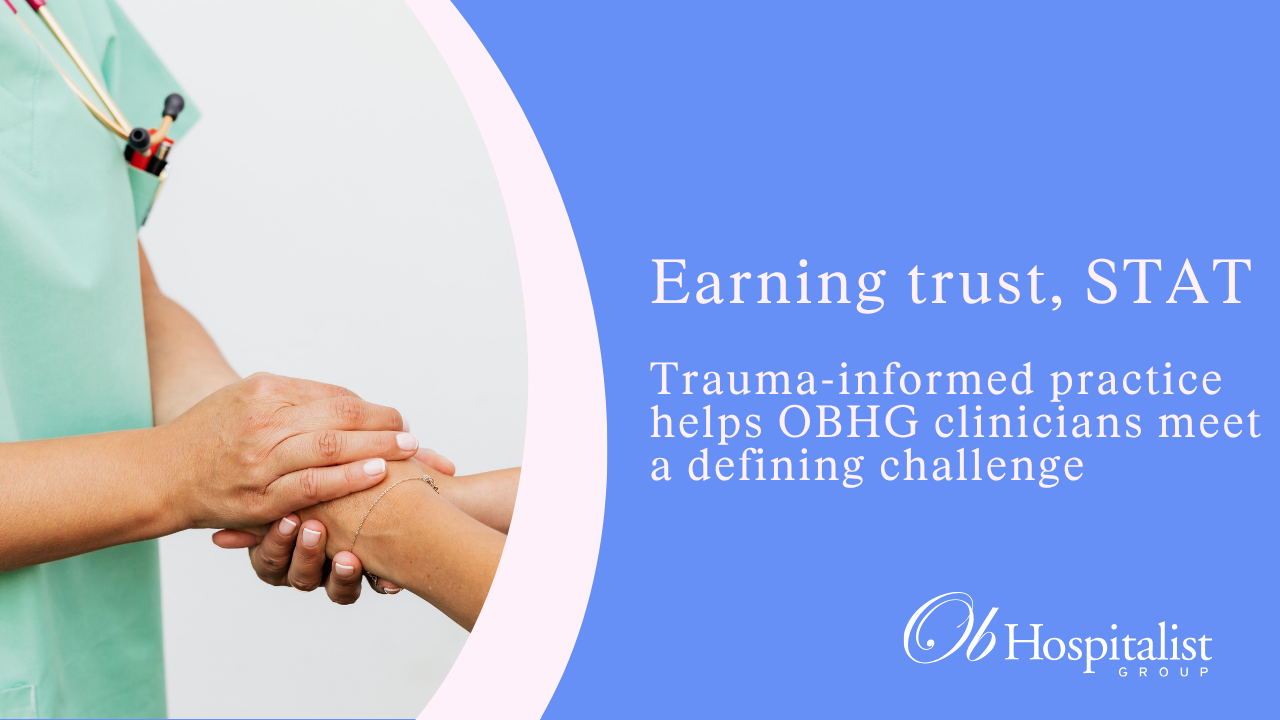
When a laboring patient arrives at the hospital for the first time, anxious and guarded, an OB hospitalist has minutes, sometimes seconds, to build the kind of trust that a private-practice physician develops over years. It’s one of the defining challenges of hospital-based OB/GYN care, and it’s one that OBHG clinicians are meeting head-on through trauma-informed practice.

“We don’t have a longstanding rapport with these patients,” says Dr. Christopher Ackerman, an OBHG site director who presented on patient-centered care at the 93rd annual conference of The American College of Osteopathic Obstetricians and Gynecologists (ACOOG). “We’re building trust in moments. And for some patients, there are additional barriers: cultural differences, gender, a history with the medical system that hasn’t always served them well.”
Granting autonomy to the patient
Trauma-informed care isn’t a new concept, but its prominence in obstetrics has grown sharply in recent years. Research published in the journal Pregnancy found that roughly one in three pregnant patients reports at least one traumatic life event, and that trauma-informed approaches are associated with improved care engagement, reduced cesarean risk, and better psychological outcomes. A Committee Opinion on the subject from the American College of Obstetricians and Gynecologists urges OB/GYNs to implement trauma-informed approaches across every level of practice, with close attention to resilience and destigmatization.
“Ask before you touch. Explain what you’re doing and why. You’re having a conversation out loud.”
–Dr. Christopher Ackerman
For OB hospitalists, the stakes are uniquely high. Without the benefit of an established patient relationship, every interaction carries disproportionate weight. But the core approach is simple, says Dr. Ackerman: “Ask before you touch. Explain what you’re doing and why. You’re having a conversation out loud.”
The goal, he says, is to give the patient autonomy rather than take it away, even in fast-moving clinical situations.
‘You have time’
Dr. Alexandre West, an OB hospitalist at the Hospital of Central Connecticut, takes that principle further. In a recent presentation, Dr. West walked OBHG clinicians through practical techniques for maintaining patient-centered care even in emergencies.

“A lot of us will say, ‘I don’t have time to ask permission. I just have to go in and do what I have to do,’” she told attendees. “You have time. It can be as quick as, ‘Your baby’s heart rate is very low. I’d like to do an exam to figure out what to do next to help your baby.’”
Dr. West also addressed one of trauma-informed care’s quieter benefits: its effect on the clinicians who practice it. OB/GYN burnout rates range from 40 to 75 percent, and up to 80 percent of providers report experiencing a distressing patient event within the past year. Training in trauma-informed care has been shown to improve provider resiliency, increase compassion, and reduce burnout, outcomes that matter as much for recruitment and retention as they do for patient safety.
Both physicians emphasize that trauma-informed care is not about adding steps to an already demanding workflow. It’s about reframing the ones that are already there. Sitting down instead of standing over a patient. Replacing the word “relax” with “let your knees fall to the side.” Offering choices, even small ones, so a patient in crisis retains some sense of control.
At OBHG, this kind of clinical culture is built into the fabric of the organization, from continuing education to the daily practice of clinicians across the country. For physicians drawn to the intensity and variety of hospital-based OB/GYN, it represents something equally important: an environment where doing the work well means doing it with intention, and where the support to practice that way is part of the job.
Keys to patient-centered care for OB hospitalists:
-
Setting expectations: Describe each procedural step and explain what the patient might feel and for how long.
-
Shared decision-making: Discuss the available pain control options and honor the patient’s preference. Document the individualized plan.
-
Anxiety reduction: Along with adequate pre-procedural counseling, guided breathing exercises, a calm clinical environment, and the presence of a support person can be useful.
-
Trauma-informed care: Ask permission before touching the patient, and empower her with as much control as possible. Pause when requested, and ensure privacy and dignity.