

Maternal health has entered a new era of accountability.
Hospital leaders are being asked to deliver safer outcomes, expand access, and advance equity, often simultaneously, with fewer resources, and under greater scrutiny. The question is no longer whether maternal care needs to improve, but how to do so in a way that is clinically sound, financially responsible, and sustainable for the workforce.
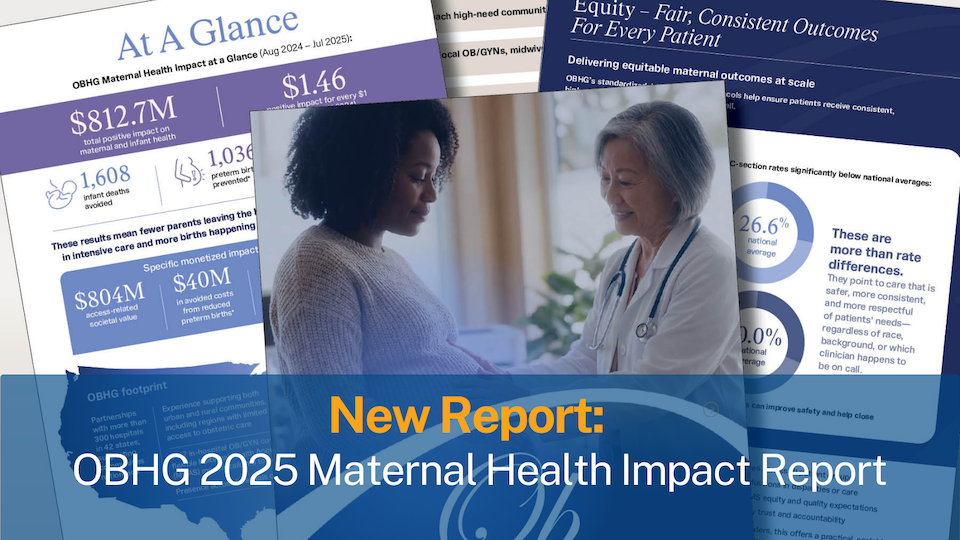
The newly-released 2025 OBHG Maternal Health Impact Report answers that question with evidence.
Developed in partnership with RGS using impact accounting, the report quantifies what many clinicians and communities already feel: that reliable, in-hospital OB/GYN coverage and standardized care models change outcomes for mothers, babies, and the systems that serve them.
Maternal health has become a defining test of hospital leadership.
Today’s hospitals are evaluated not just on financial performance, but on whether they can deliver safe outcomes, protect access to care, and close equity gaps—often in the face of workforce shortages, rising acuity, and fragile service lines. The pressure is real. So are the consequences.
That’s why metrics matter. But metrics alone don’t tell the full story.
Between August 2024 and July 2025, Ob Hospitalist Group generated $812.7 million in measurable maternal and infant health impact, delivering $1.46 in societal and medical value for every $1 of revenue. Those numbers are important. They help boards, payers, and regulators understand scale.
What they represent is even more important.
They represent 1,608 babies who went home, 1,036 preterm births prevented, and 500 severe maternal morbidity events avoided. They represent fewer emergency escalations at 2 a.m., fewer families separated by NICU walls, and fewer clinicians carrying the moral distress of “if only we had gotten there sooner.”
Behind every data point is a moment that could have gone very differently.
For hospital leaders, this is where maternal health impact becomes real. It’s not just about improving scores; it’s about creating a system where:
- Someone is always present when labor changes fast
- Care decisions are consistent, not dependent on who happens to be on call
- Access doesn’t disappear because geography or staffing makes it inconvenient
OBHG’s impact is driven by three pillars—quality, access, and equity—but what unites them is reliability. Reliability for patients. Reliability for clinicians. Reliability for health systems trying to sustain maternity services in an increasingly volatile environment.
The dollars help quantify the value. The real return is measured in safer births, intact families, and care teams who can keep doing this work without burning out.
See what this impact could look like at your hospital.
Request a customized consultation to explore outcomes, access, and equity opportunities specific to your community.