

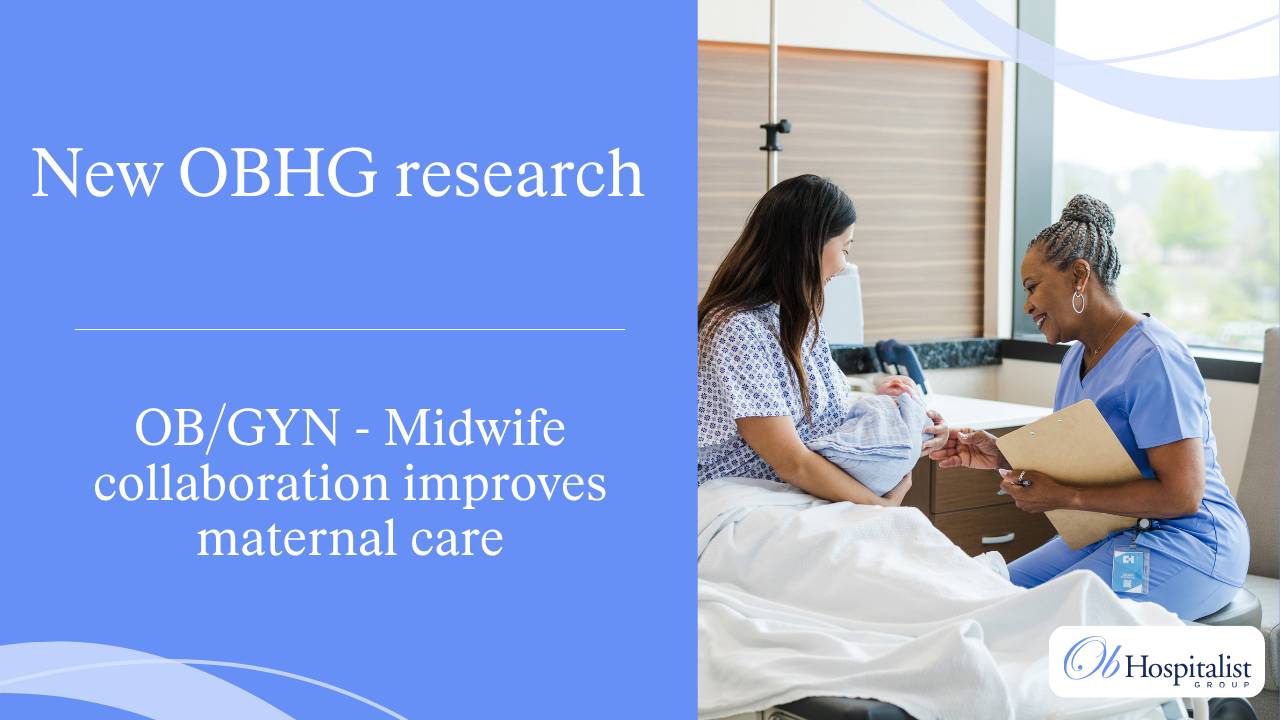
As OB/GYN shortages, burnout and rural healthcare deserts continue unabated in the United States, certified nurse-midwives (CNMs) are a critical solution to the maternal care crisis. New data from Ob Hospitalist Group (OBHG) adds to the abundant research that hospital collaboration with midwives doesn’t just fill staffing gaps. Midwives improve maternal care outcomes.
A recent quality performance analysis at 265 OBHG hospital partner sites across the country compared 57 certified nurse midwife (CNM) sites with non-CNM sites. Findings showed CNM sites outperformed non-CNM sites on 5 out of 6 quality metrics.
What new OBHG data shows about CNM care
The following data were collected at OBHG partner sites from August 2025 through July 2026:
- Lower rates of C-section: Sites with CNMs had a 4% reduction in NTSV+ C-sections compared to the national average.
- Significantly reduced episiotomy rates: CNM-integrated sites showed a 6% lower rate of episiotomies than the national average.
- Fewer severe lacerations: The incidence of 3rd/4th-degree perineal lacerations without an instrument was 1% lower relative to national performance at CNM-integrated sites.
- Improved Outcomes in Instrument-Assisted Deliveries: Hospitals with OBHG CNMs had 1% fewer severe lacerations than the national average.
Episiotomy rates differed significantly between CNM sites and non-CNM sites. The rate of 3rd/4th-degree lacerations with instrument-assisted delivery was higher at CNM sites but still below the target and national average.
The results highlight the value of collaborative care between OB/GYNs and CNMs that improves patient safety, reduces unnecessary interventions and provides high-quality, personalized maternity care. “The recent data reinforces that certified nurse-midwives enhance maternal care by reducing unnecessary interventions, advancing safety and improving key outcomes,” says Dr. Mark Simon, Chief Medical Officer of OBHG.
Improving satisfaction and outcomes with CNM integration
OBHG employs more than 350 full-time certified nurse-midwives nationwide. That number rises to nearly 500 when including PRN and part-time providers.
Rather than replacing OB/GYNs, CNMs at OBHG are collaborative partners who complement physicians in sites with midwife integration. Midwives are experts in normal, healthy pregnancies and labor and delivery. They bring deep expertise in both physiologic and high-risk birth, education and support, while OB/GYNs bring critical medical and surgical expertise for high-risk and acute cases. Together, CNMs and OB/GYNs collaborate to measurably improve outcomes.
“Midwifery is rooted in providing personalized, patient-centered care, playing a powerful role in improving birth outcomes. This new data shows that by working alongside OB/GYNs in the hospital setting, CNMs help reduce C-section rates, improve vaginal delivery outcomes, and ensure that every patient receives the attentive, evidence-based care they deserve,” says Amanda McPherson Shafton, CNM, DNP, National Director of Midwifery at OBHG.
How midwifery-physician collaboration works at the bedside
At OBHG sites, women aren’t divided into “midwife patients” and “doctor patients.” Physicians and midwives work collaboratively, with the hospitalist team serving as a safety net for patients and community clinicians.
A midwife may support physiologic labor, education and shared decision-making. If the patient’s condition changes or medical or surgical intervention becomes necessary, an OBHG physician is immediately available. The model expands access to care and allows each highly trained clinician to work at the top of their license.
Thoughtful intervention when necessary
While midwifery is associated with fewer interventions, the goal isn’t to avoid essential intervention. Pitocin, epidural anesthesia, cesarean delivery and other interventions are no doubt important components of safe maternal care. Evidence-based practice emphasizes clinically appropriate intervention for the right patient at the right time.
Integrating CNMs into maternity care ensures more patients receive the appropriate level of individualized support when they need it most.
Data from OBHG sites with CNMs show lower rates of cesarean delivery and episiotomy, suggesting that collaborative physician-midwife care may support fewer interventions when clinically appropriate.
OB-midwife teams can strengthen the entire maternal care workforce
The benefits of adding CNMs extend beyond individual patients. “More midwives improve culture, patient outcomes, nursing staff satisfaction and even work-life balance for our physician collaborators,” says Shafton.
Particularly in rural areas plagued by OB shortages, CNMs and other advanced practice clinicians expand the pool of maternal health professionals. Clinicians already living and working as nurses in these rural areas can pursue advanced midwifery education and ultimately provide care in communities they already know.
“Rural hospitals are closing and forcing people to travel farther for their prenatal and birth care. The idea of making sure we have a workforce that includes midwives and physicians reduces burnout and sustains full scope practice for more providers,” says Shafton.
OBHG’s latest quality performance analysis data adds to the compelling reasons for hospitals to examine the OB-CNM collaborative care model more closely. When physicians and midwives practice as a team, the benefits extend beyond patients to the overall obstetric service line performance and sustainability.