
Hospitals with residency programs carry a dual responsibility: delivering exceptional patient care while training the next generation of clinicians. That balance isn’t always easy—especially in obstetrics, where acuity can shift quickly and supervision must be immediate, experienced, and consistent.
That’s where Ob Hospitalist Group (OBHG) makes a measurable difference.
Creating a stronger learning environment
OBHG’s OB hospitalist model is built on continuous, in-hospital coverage by experienced OB/GYN physicians. For teaching hospitals, that 24/7 presence does more than improve response times—it creates a reliable, structured environment for resident and student oversight.
Unlike traditional on-call models, OBHG clinicians are always physically present on the unit. Learners have immediate access to attending-level guidance during critical moments—whether managing a shoulder dystocia at 2 a.m. or navigating complex triage decisions during peak hours.
The result is a safer, more supportive learning environment that benefits both patients and trainees.
“As OBHG hospitalists, we are in a unique position to work and teach alongside OB/GYN and Family Practice residents, offering both hands-on clinical experience and valuable didactic learning opportunities,” said OBHG clinician Dr. Eric Colton.
A measurable commitment to clinical education
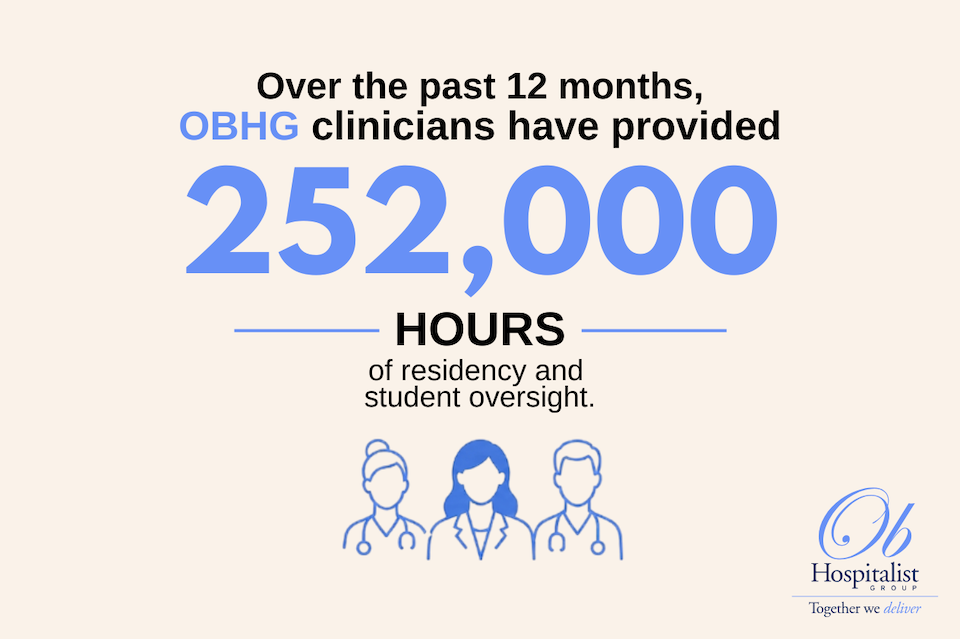
In the past year alone, OBHG clinicians have provided 252,000 hours of residency and student oversight across 185 programs nationwide.
This number reflects more than coverage, it represents sustained investment in education, including:
- Real-time teaching at the bedside
- Continuous supervision during high-risk and high-acuity cases
- Consistent mentorship that reinforces best practices and clinical confidence
For hospital partners, this level of engagement helps ensure that training programs are not only compliant, but truly robust.
Enhancing safety and confidence for learners
In obstetrics, timing matters. When complications arise, there’s no margin for delay—and no substitute for experienced oversight.
OBHG clinicians provide:
- Immediate availability for escalation when residents encounter complex cases
- Hands-on guidance during procedures and emergent situations
- Support in clinical decision-making, helping learners develop sound judgment
This consistent presence reduces variability in care and gives residents the confidence to grow within a structured, supportive framework.
“Working with residents is both a privilege and a responsibility,” said Dr. Colton. It allows us to help shape the next generation of physicians while introducing them to career paths they may not have previously considered.”
Supporting program accreditation and growth
Strong oversight is a cornerstone of residency program accreditation and sustainability. OBHG helps hospitals:
- Meet supervision requirements set by accrediting bodies
- Standardize teaching across shifts and providers
- Reduce gaps in coverage that can strain faculty and staff
By integrating seamlessly into existing teams, OBHG clinicians enhance—not replace—the educational mission of the hospital.
Easing the burden on core faculty
Faculty physicians often juggle competing priorities: clinical care, teaching, administrative responsibilities, and research. OBHG helps alleviate that pressure by ensuring that residents always have access to qualified supervision, even when faculty are off-site.
This allows core faculty to focus on higher-level teaching and program development, while maintaining confidence that patient care and trainee oversight remain strong around the clock.
A real-world example: supporting family medicine residents in Tennessee
At West Tennessee Healthcare Jackson-Madison County General Hospital in Jackson, TN, OBHG partners with the University of Tennessee Family Medicine residency program to expand both care capacity and training opportunities.
With only one OB/GYN on staff, OBHG clinicians play a critical role in managing obstetric volume and supporting residents. During scheduled resident rotations, OBHG clinicians deliver hands-on teaching in real clinical settings.
Through this collaboration, OBHG enhances the training experience for family medicine residents while maintaining high-quality patient care. OBHG clinicians manage a substantial number of deliveries and are recognized for their meaningful contributions to the program.
That impact is reflected not only in patient outcomes, but also in recognition, OBHG’s Site Director was named the program’s Outstanding Clinical Specialty of the Year.
Investing in the future of women’s health
The demand for well-trained OB/GYNs continues to grow. Hospitals that prioritize both patient care and education are best positioned to meet that need.
With more than 252,000 hours of oversight delivered in a single year, OBHG is proud to support not only today’s patients, but tomorrow’s clinicians.
Ready to see what stable, sustainable OB coverage can look like for your hospital—while strengthening residency programs and ensuring consistent student oversight? Connect with us.