How one OB-GYN found work-life balance after 30 years in private practice
08/18/26
How one OB-GYN found work-life balance after 30 years in private practice
For 30 years, Dr. John Marcus ran a solo OB-GYN practice in Ridgewood, New Jersey, a leafy bedroom community just outside New York City. He built his practice from scratch, earned the loyalty of generations of patients, and served in leadership roles from department director to chief of the local medical society.
By every conventional measure, the practice was a success. But Dr. Marcus found that there was one measure that came short: work/life balance.
“I gave my patients a 24/7, 365 guarantee, and it’s pretty hard,” he says.
Dr. John Marcus
“I go to new places, I make new friends, I do good work, I learn how they do it, and I consequently become even better.”
Dr. John Marcus
The work meant days in the office followed by nights in the hospital followed by days in the office. It meant no separation between professional and personal life, because there was no personal life to separate. It meant expenses that kept running whether or not he was there to generate revenue. And it meant never experiencing what Dr. Marcus describes using a German word with no English equivalent: Feierabend, the deep, settled satisfaction you feel at the end of a hard day’s work, knowing you can finally rest.
“A private, solo obstetrician never gets Feierabend,” he says, “because it’s always work. You’re never off.”
When an opportunity for change knocked, Dr. Marcus’s wife heard it first. Liz Marcus, a labor nurse herself, spotted an OBHG recruiting ad online. She made the pitch: move to the house they’d already bought in Florida, work seven 24-hour shifts a month, draw a competitive salary with benefits, and stop running a practice that was consuming him.
“She drove this,” Dr. Marcus says. “She said, “Look at this. You can go to Florida, work seven days a month, the rest of the time you’re off. Why are you working 24/7 doing what you’re doing?’”
As any good husband would, he listened.
The Diplomat life
Today, Dr. Marcus serves as a Site Director and Regional Diplomat for Ob Hospitalist Group (OBHG), the nation’s largest dedicated OB-GYN hospitalist provider. In the Regional Diplomat program, he travels to partner hospitals across Florida, leading medical teams and implementing best practices while OBHG covers travel and housing. It’s a role that rewards clinical range and interpersonal skill in equal measure, and Dr. Marcus has found it suits him.
“I go to new places, I make new friends, I do good work, I learn how they do it, and I consequently become even better,” he says.
Traveling between hospitals has given him a rare vantage point on clinical variation. He has seen firsthand how protocols, naming conventions, and standards of care differ from facility to facility, sometimes for good reason and sometimes not. As the “Diplomat” title suggests, the role demands tact.
“I have to be very diplomatic about how I bring best practices wherever I go,” he says — with the knowing emphasis of someone who has watched less diplomatic colleagues flame out.
That broad exposure has sharpened his clinical instincts. Dr. Marcus maintains a personal cesarean-section rate of 14%, well below the national average of 32.4%, a figure he attributes to confident fetal heart tracing interpretation and a willingness to trust the science when others reach for surgical intervention.
“There is absolutely no doubt in my mind that I have the best safety protocols, standards, and plans of care around, because I see all the best practices,” he says.
It’s showtime!
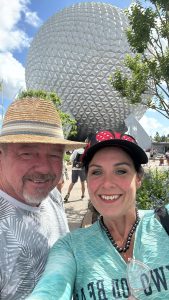
Dr. John Marcus and his wife, Liz, enjoy a day at EPCOT.
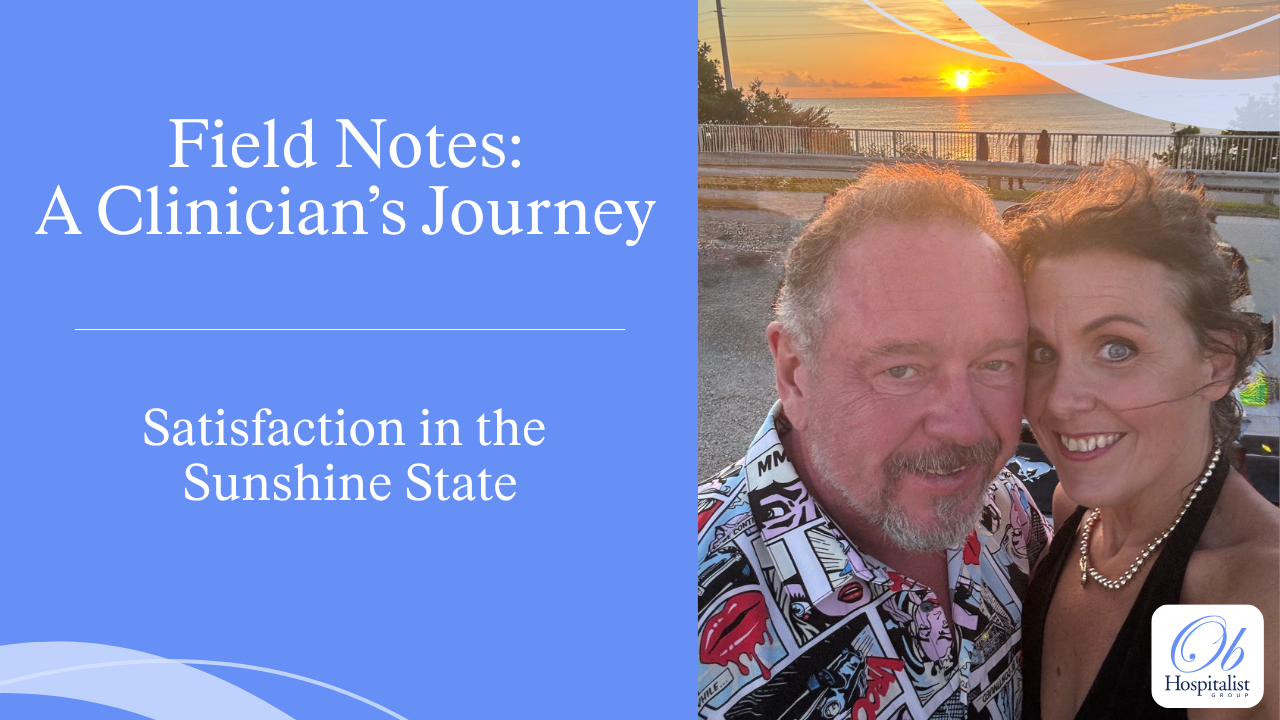
Dr. Marcus and Liz settled in Punta Gorda, on Florida’s Gulf Coast between Fort Myers and Sarasota. Their home backs up to a mangrove preserve, which means permanent privacy, unobstructed sky, and what the couple calls “showtime” each evening: the moment the sun drops toward the horizon and lights up in gold and rose red over the trees.
“We celebrate it every night,” says Dr. Marcus.
He’s the first to point out contrasts with his former life. In New Jersey, going home meant shoveling snow, raking leaves, and waiting for the phone to ring. In Florida, clocking off a shift means something different entirely.
“When you clock off your job, you don’t just go home,” he says. “You clock into a vacation-style life.”
He talks about Freedom Boat Club memberships, about exploring Jacksonville’s parks and Miami’s neighborhoods between assignments, about traveling with Liz and improving their home together. He talks about the colleagues he’s met who share his love of movement and discovery. But what he returns to, again and again, is Feierabend: the permission to stop, to exhale, to know the day is actually over.
“You cannot put a price on the value of a life well-lived,” Dr. Marcus says. “I believe we are paraphrasing Socrates.”
To provide the best experiences, we use technologies like cookies to store and/or access device information. Consenting to these technologies will allow us to process data such as browsing behavior or unique IDs on this site. Not consenting or withdrawing consent, may adversely affect certain features and functions.
Functional
Always active
The technical storage or access is strictly necessary for the legitimate purpose of enabling the use of a specific service explicitly requested by the subscriber or user, or for the sole purpose of carrying out the transmission of a communication over an electronic communications network.
Preferences
The technical storage or access is necessary for the legitimate purpose of storing preferences that are not requested by the subscriber or user.
Statistics
The technical storage or access that is used exclusively for statistical purposes.The technical storage or access that is used exclusively for anonymous statistical purposes. Without a subpoena, voluntary compliance on the part of your Internet Service Provider, or additional records from a third party, information stored or retrieved for this purpose alone cannot usually be used to identify you.
Marketing
The technical storage or access is required to create user profiles to send advertising, or to track the user on a website or across several websites for similar marketing purposes.